Case studies / selected systems

Case studies that leave a trace.

10 case studies, read as working instruments: the constraint, the path through it, and only the outcomes that are confirmed. Client work, one ongoing rebuild and portfolio projects.

01 / Client work
FeaturedOngoingFreight & logistics

US freight broker (confidential)

Freight brokerage TMS platform

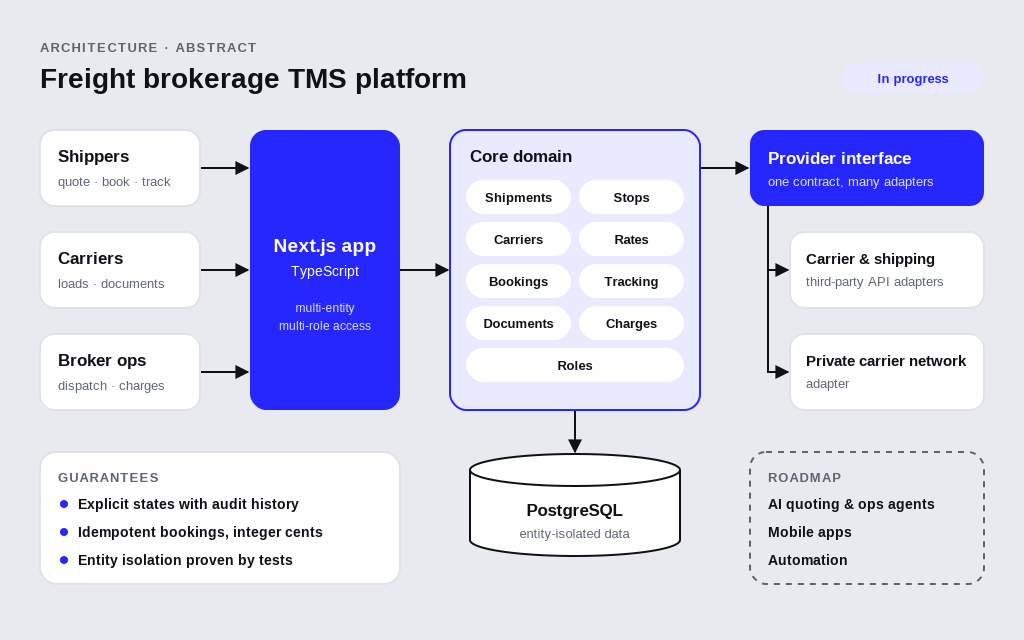
An ongoing, ground-up rebuild of a freight brokerage's quoting, booking, dispatch and management platform for shippers and carriers, with Sumit as the solo engineer. It is still in progress and has no outcome numbers yet; so far every shipment has an audited lifecycle, bookings and money stay correct when a request repeats, and carrier systems sit behind one interface.

Solo engineer on a ground-up rebuild of a freight quoting, booking, dispatch and management platform for shippers and carriers. In progress since October 2026; the roadmap includes AI quoting and operations agents, mobile apps and automation.

Last updated

Client
US freight broker (confidential)
Industry
Freight & logistics
Engagement
Ground-up rebuild of a freight quoting, booking and dispatch platform
Stack
  • Next.js
  • TypeScript
  • PostgreSQL
Abstract architecture of the freight brokerage TMS platform

01 / constraint

What was the problem?

The platform has to model the whole freight lifecycle, keep bookings and money correct when a request repeats, talk to many carrier and shipping systems through one interface, and keep each entity's data apart from the others.

02 / solution path

How was it built?

  1. 01

    Core freight domain

    Modelled shipments, stops, carriers, rates, bookings, tracking events, documents, charges and roles as one core domain.

  2. 02

    Explicit shipment states

    Shipments move through explicit state transitions, and every transition is kept in an audit history.

  3. 03

    Idempotent bookings and money

    Booking and money operations are idempotent, and all money is stored as integer cents.

  4. 04

    One provider interface

    A single provider interface, with adapters for third-party carrier and shipping APIs and the private carrier network.

  5. 05

    Entity isolation

    Multi-entity, multi-role access, with entity isolation proven by tests.

No numeric outcome is attached to this study. The system flow is documented instead of overstated.

Back to index
02 / Client work
FeaturedManaged cloud services

Stackways

Stackways

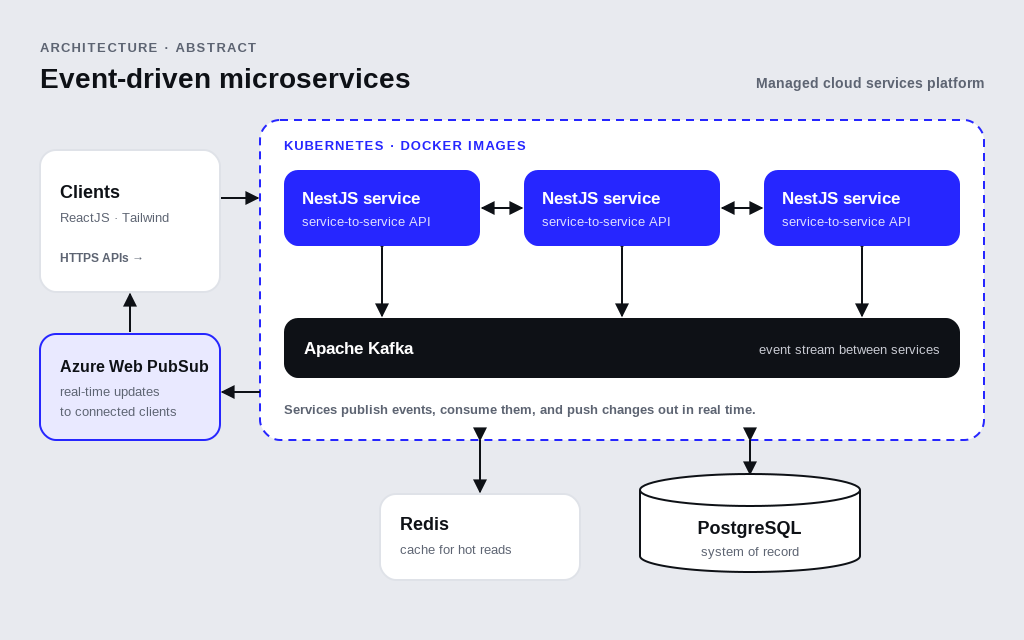
Event-driven NestJS microservices for Stackways, a managed cloud services provider, built at Softobiz from February 2022. The services talk over Apache Kafka, push real-time updates to customers over Azure Web PubSub and deploy as containers on Kubernetes.

Server-side microservices for a managed cloud services provider's distributed system, built at Softobiz from February 2022: event-driven services on Apache Kafka, real-time updates over Azure Web PubSub, Redis caching and containerised deploys on Kubernetes.

Last updated

Client
Stackways
Industry
Managed cloud services
Engagement
Distributed microservices for a managed cloud services provider
Stack
  • NestJS
  • ReactJS
  • Tailwind
  • PostgreSQL
  • Redis
  • Apache Kafka
  • Azure Web PubSub
  • Docker
  • Kubernetes
Abstract architecture of event-driven microservices for a managed cloud platform

01 / constraint

What was the problem?

A distributed platform needs service-to-service APIs that stay reliable as it grows, and its customers expect changes to show up in real time.

02 / solution path

How was it built?

  1. 01

    Event-driven microservices

    Built NestJS services that talk through Apache Kafka events and service-to-service APIs.

  2. 02

    Real-time updates

    Pushed state changes to connected clients over Azure Web PubSub.

  3. 03

    Data and caching

    Kept PostgreSQL as the system of record, with Redis caching for frequently read data.

  4. 04

    Containerised deploys

    Packaged the services as Docker images and deployed them on Kubernetes.

No numeric outcome is attached to this study. The system flow is documented instead of overstated.

Back to index
03 / Client work
FeaturedB2B SaaSIndustrial data & compliance

Industrial data compliance client

Industrial Data Compliance & Analytics Platform

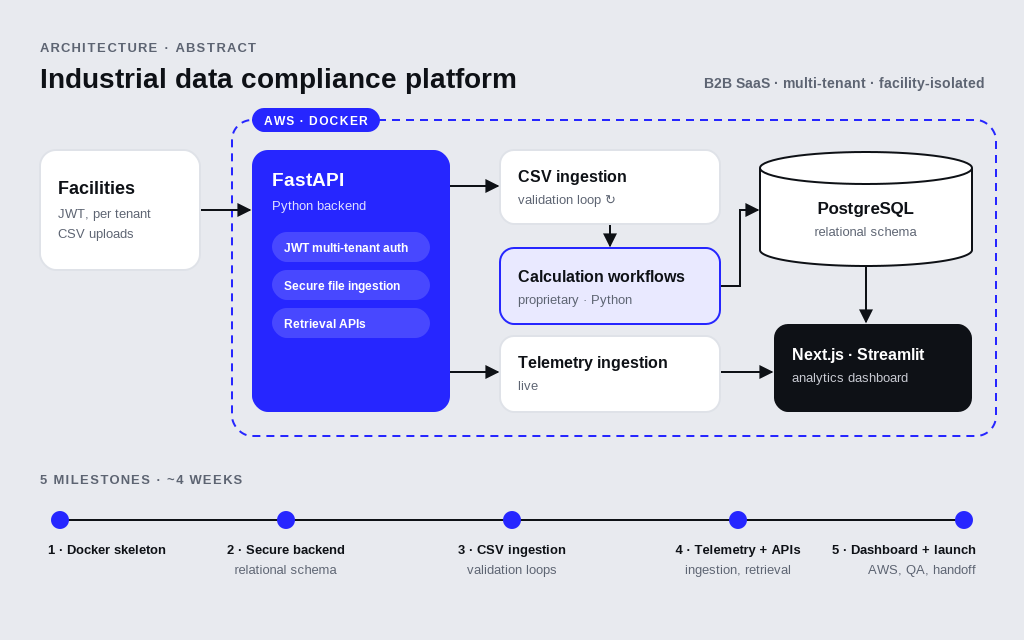
A secure, multi-tenant B2B SaaS platform that lets an industrial data compliance client ingest, validate and analyse effluent discharge data, with each facility's data kept apart. Five milestones, from the Docker skeleton to the AWS launch and handoff, were delivered in about four weeks.

A secure, real-time B2B SaaS platform for industrial effluent discharge data: multi-tenant, facility-isolated access, telemetry ingestion and proprietary calculation workflows, built on FastAPI, PostgreSQL and Next.js with a Streamlit dashboard, and deployed on AWS.

Last updated

Client
Industrial data compliance client
Industry
Industrial data & compliance
Engagement
B2B SaaS platform for industrial data compliance and analytics
Stack
  • Python
  • FastAPI
  • PostgreSQL
  • Next.js
  • Streamlit
  • Docker
  • AWS
Abstract architecture of the industrial data compliance and analytics platform

01 / constraint

What was the problem?

Each facility's data had to stay apart from every other facility's, uploads and live telemetry had to be checked before the calculations ran, and the results needed a responsive dashboard.

02 / solution path

How was it built?

  1. 01

    Docker skeleton

    Set up the containerised project skeleton the rest of the work builds on.

  2. 02

    Multi-tenant, facility-isolated backend

    Built the FastAPI backend with JWT multi-tenant login, facility-isolated access and the PostgreSQL relational schema.

  3. 03

    Validated ingestion and calculations

    Added CSV ingestion with validation loops ahead of the proprietary calculation workflows in Python.

  4. 04

    Telemetry and data APIs

    Added live telemetry ingestion and the retrieval APIs.

  5. 05

    Dashboard, launch and handoff

    Shipped the Next.js frontend and Streamlit dashboard, launched on AWS, and finished QA and handoff.

Observed outcomes

5Milestones delivered in ~4 weeks

Five milestones, from the Docker skeleton to the AWS launch and handoff, delivered in about four weeks.

Back to index
04 / Portfolio project
Logistics operations

Portfolio project

Handoff Control Tower

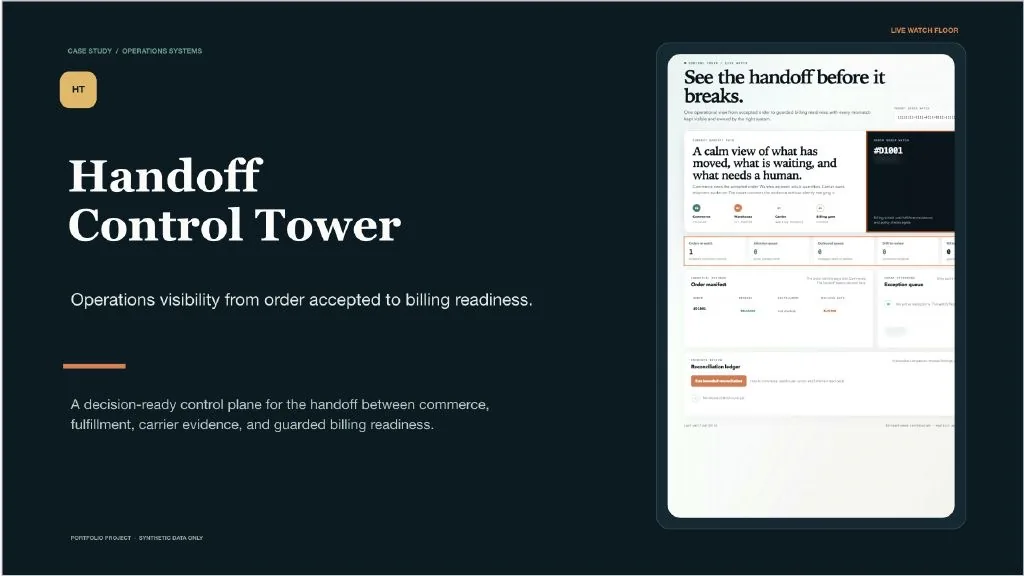
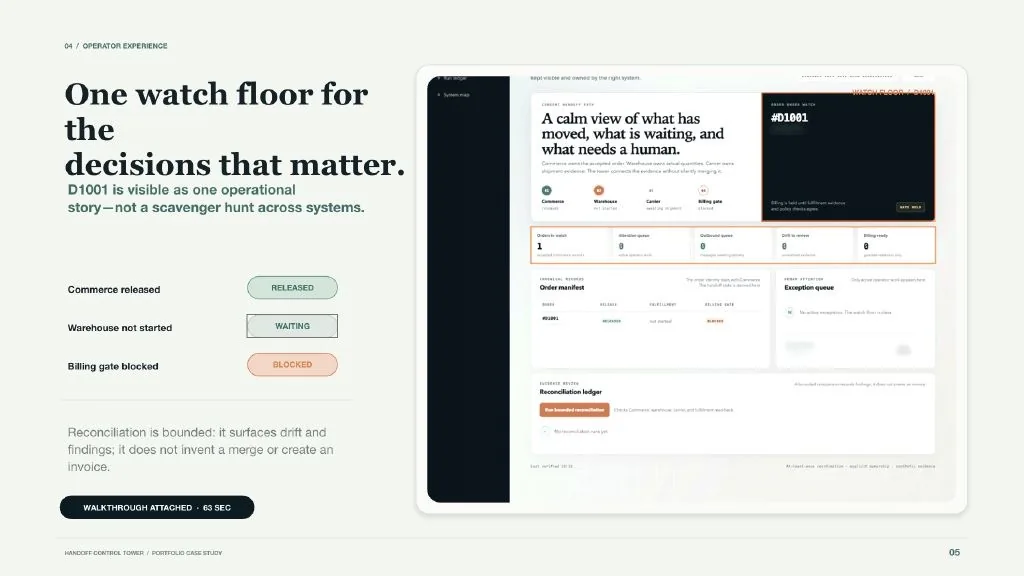
A portfolio project that shows logistics operations teams where each order stands between commerce, warehouse, carrier and billing. It surfaces exceptions and missing evidence for a person to review, and never invents a merge or an invoice.

Makes the handoffs between commerce, warehouse, carrier and billing visible in one place: what has moved, what is waiting, which system owns the truth, what evidence is missing and what needs a human. Built as a portfolio project.

Client
Portfolio project
Industry
Logistics operations
Engagement
Order-to-billing operations visibility
Stack
  • Next.js
  • FastAPI
  • NestJS
  • Drizzle
  • PostgreSQL
  • Redis
  • pnpm workspaces
Handoff Control Tower cover slide, showing the live watch floor

01 / constraint

What was the problem?

Orders cross several systems between intake and invoice, and reconciliation tools tend to guess when records disagree. The console had to surface exceptions without ever inventing a merge or an invoice.

02 / solution path

How was it built?

  1. 01

    Watch floor

    Shows an order such as D1001 as one operational story, next to an order manifest and an exception queue.

  2. 02

    Bounded reconciliation ledger

    Preserves evidence and exposes drift through a bounded reconciliation that flags findings for review and never invents merges.

  3. 03

    State with outbound intent

    Commits each state change together with its outbound intent, so recovery stays safe under at-least-once delivery.

  4. 04

    Guarded billing readiness

    Gives guarded billing-readiness signals instead of generating invoices automatically.

  5. 05

    Tenant-scoped guards

    Scopes every read and write to its tenant, with deterministic adapters and mocks for outside systems.

  6. 06

    Operational safety

    Migration-from-zero checks, a safe reset guard, and liveness and readiness checks for the app, Postgres and Redis.

  7. 07

    Framework-free domain

    Keeps the domain code free of frameworks, with no remote I/O inside database transactions.

No numeric outcome is attached to this study. The system flow is documented instead of overstated.

Back to index
05 / Portfolio project
3PL operations

Portfolio project

Ops Intake Agent

A portfolio demo of AI-assisted document intake for 3PL booking and fulfillment requests. A model reads the emails, PDFs, spreadsheets and images, but evidence, deterministic validation and human review decide every operational action.

AI-assisted document intake for 3PL booking and fulfillment requests, where evidence, deterministic validation and human review control every operational action. A portfolio demo with mock operations and no live OMS or WMS integration.

Client
Portfolio project
Industry
3PL operations
Engagement
AI-assisted document intake for booking and fulfillment requests
Stack
  • Python
  • FastAPI
  • Pydantic
  • SQLAlchemy
  • PostgreSQL
  • LangGraph
  • Dramatiq
  • Redis
  • Next.js
  • React
  • TypeScript
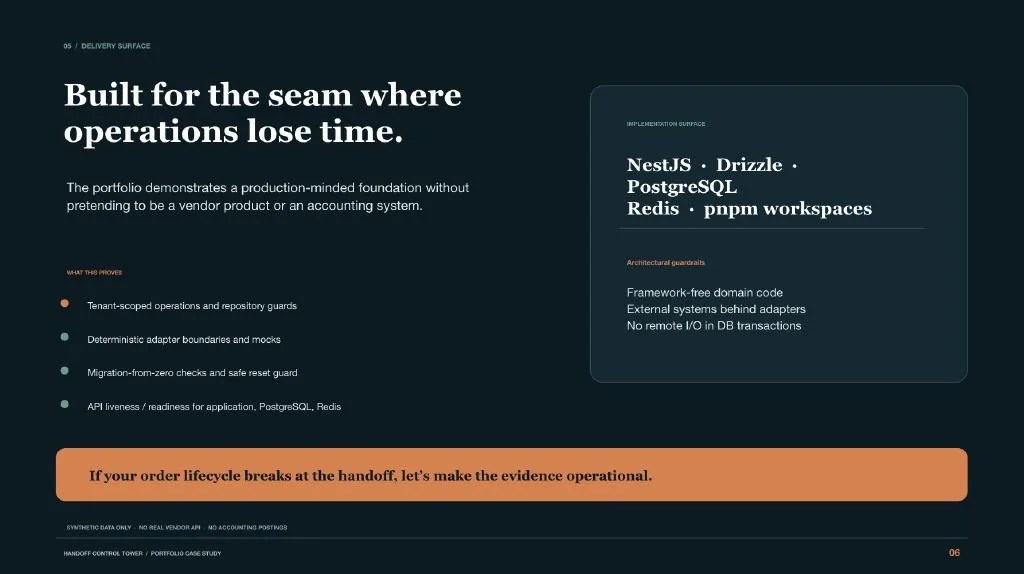
Abstract architecture of AI-assisted document intake with validation and human review

01 / constraint

What was the problem?

Requests arrive as emails, PDFs, spreadsheets and images. A model can read them, but it must not act on a guess when information is missing or uncertain.

02 / solution path

How was it built?

  1. 01

    Bounded parsing

    Routes email text, PDFs, CSV/XLSX spreadsheets and images through bounded parsing and OCR workflows.

  2. 02

    Evidence-backed extraction

    Produces schema-constrained extraction proposals with per-field source evidence, plus tenant-filtered SOP retrieval with citations.

  3. 03

    Human review

    Uses LangGraph workflows with human review interrupts for missing or uncertain information.

  4. 04

    Verified actions

    Creates immutable action previews, revalidates authorization and policy, and runs approved actions through an idempotent mock operations adapter with read-back verification.

  5. 05

    Isolation and recovery

    Tenant isolation, audit timelines, recovery handling and an evaluation suite.

No numeric outcome is attached to this study. The system flow is documented instead of overstated.

Back to index
06 / Client work
E-commerce

Falcon CRO

Falcon CRO

The asynchronous processing layer, traffic attribution and core A/B testing engine of Falcon CRO, a Shopify A/B testing and behavioral analytics app. The rebuild improved P90 latency 3x and Core Web Vitals 8x for its Shopify App Store submission.

Rebuilt the asynchronous processing layer of a Shopify A/B testing and behavioral analytics app, and engineered its traffic attribution and core A/B testing features.

Client
Falcon CRO
Industry
E-commerce
Engagement
Shopify A/B testing and behavioral analytics app
Stack
  • Shopify
  • BullMQ
  • Redis
  • PM2
Illustrative interface / Sample data processing
queue queuedone active jobsafe delivery
payment.capturedsample event / idempotentdone
session.replayedsample event / idempotentdone
cart.updatedsample event / waitingdone
bullmqpm2 clusterretry safe

01 / constraint

What was the problem?

During sales spikes the server throttled and payment events were dropped, and the app needed strong runtime performance for Shopify App Store submission.

02 / solution path

How was it built?

  1. 01

    Asynchronous processing

    Implemented BullMQ processing and Redis-based aggregation queues.

  2. 02

    Idempotent handling

    Added idempotent event and payment handling, so repeated deliveries are safe.

  3. 03

    Cluster scaling

    Configured PM2 cluster mode for horizontal scaling.

  4. 04

    Conversion features

    Engineered traffic attribution and the core A/B testing engine for conversion rate optimization.

Observed outcomes

3xP90 latency

Improvement in P90 latency.

8xCore Web Vitals

Improvement in Core Web Vitals for Shopify App Store submission.

Back to index
07 / Client work
Salesforce analytics

SFMC Studio

SFMC Studio

Rebuilt data ingestion and aggregation pipelines for SFMC Studio, a Salesforce analytics platform whose enterprise clients were getting reporting errors from inaccurate metrics and slow processing. Metrics accuracy improved 5x and web vitals 2x.

Rebuilt the data ingestion and aggregation pipelines of a Salesforce analytics platform after inaccurate metrics and slow processing caused reporting errors for enterprise clients.

Client
SFMC Studio
Industry
Salesforce analytics
Engagement
Salesforce analytics platform
Stack
  • Salesforce
  • MongoDB
Illustrative interface / Sample data stream stable
sourceSalesforcecloud records
bufferQueuesafe delivery
storeMongoDBreporting data
records / batchsample batch
aggregationrestructured
delivery modeidempotent

01 / constraint

What was the problem?

Inaccurate metrics and slow processing were causing downstream reporting errors, so ingestion and aggregation had to become safe, accurate and fast.

02 / solution path

How was it built?

  1. 01

    Queue-based ingestion

    Rebuilt Salesforce Cloud data ingestion around queue-based processing.

  2. 02

    Safe data delivery

    Delivered the ingested records safely and accurately into MongoDB.

  3. 03

    Aggregation restructuring

    Restructured the aggregation layer to improve reporting accuracy and application performance.

Observed outcomes

5xMetrics accuracy

Improvement in metrics accuracy.

2xWeb vitals

Improvement in web vitals.

Back to index
08 / Client work
Knowledge management

Lexilift AI

Lexilift AI

The complete ingestion and query pipeline, built from scratch, of Lexilift AI, a retrieval-augmented generation (RAG) SaaS platform for multi-domain business knowledge bases. Documents go in through chunking and embeddings, and answers come back through context retrieval and a streaming query API.

Architected and built, from scratch, the complete ingestion and query pipeline of a retrieval-augmented generation (RAG) SaaS platform serving a multi-domain business knowledge base.

Client
Lexilift AI
Industry
Knowledge management
Engagement
Multi-domain RAG SaaS knowledge base
Stack
  • RAG
  • Embeddings
  • Vector retrieval
  • Streaming API
Illustrative interface / Sample data query ready
sourceproduct-notes.mddocument loaded
chunks
sample context blocks
vectors
embedding map
answer stream

Relevant context selected. The response is assembled from the indexed source and streamed as it becomes available

01 / constraint

What was the problem?

The product needed an end-to-end path from source documents to useful, domain-aware context and streamed answers.

02 / solution path

How was it built?

  1. 01

    Document ingestion

    Built the ingestion flow for bringing source documents into the knowledge base.

  2. 02

    Chunking and embeddings

    Built the document chunking and vector embedding workflows.

  3. 03

    Retrieval and streaming queries

    Implemented context retrieval for knowledge-base queries and a streaming query API.

No numeric outcome is attached to this study. The system flow is documented instead of overstated.

Back to index
09 / Client work
Education & E-learning

Vasu Eata Tax Academy

VETA LMS

An SEO-optimised Next.js marketing website and a self-hosted, Dockerised Moodle LMS for Vasu Eata Tax Academy, an education business. Webhook success improved 4x and bulk CSV parsing 5x, and more than 20 critical- and medium-priority defects were resolved.

A Next.js portfolio and SEO-optimised marketing website for an educational technology business, extended with a Dockerised Moodle LMS on Hetzner, with AWS S3 for media.

Client
Vasu Eata Tax Academy
Industry
Education & E-learning
Engagement
SEO marketing website and self-hosted LMS
Stack
  • Next.js
  • Moodle
  • Docker Compose
  • Shell Script
  • Hetzner
  • AWS S3
Illustrative interface / Sample data courses online
learnersMoodlecourse site
hostHetznerdocker compose
mediaAWS S3course files
provisioningshell scripted
ssl renewalautomated
backupsscheduled

01 / constraint

What was the problem?

The academy needed a website that ranks in search, plus a reliable, cost-efficient LMS with full data ownership and repeatable infrastructure automation.

02 / solution path

How was it built?

  1. 01

    SEO marketing website

    Built the portfolio and marketing website with Next.js and optimised it for search engines.

  2. 02

    Containerised LMS

    Packaged Moodle and its dependencies with Docker Compose for consistent, reproducible environments.

  3. 03

    Automated provisioning

    Wrote shell scripts for server bootstrapping, SSL renewal, and scheduled backups.

  4. 04

    Cloud media offload

    Configured AWS S3 as the file store for course media, keeping the server footprint lean.

Observed outcomes

4xWebhook success rate

Improvement through idempotency and queue-based processing.

5xBulk CSV parsing

Efficiency improvement for bulk CSV parsing.

20+Defects resolved

Critical- and medium-priority defects resolved.

Back to index
10 / Client work
Lending

American Prime Lending

Custom CRM for American Prime Lending

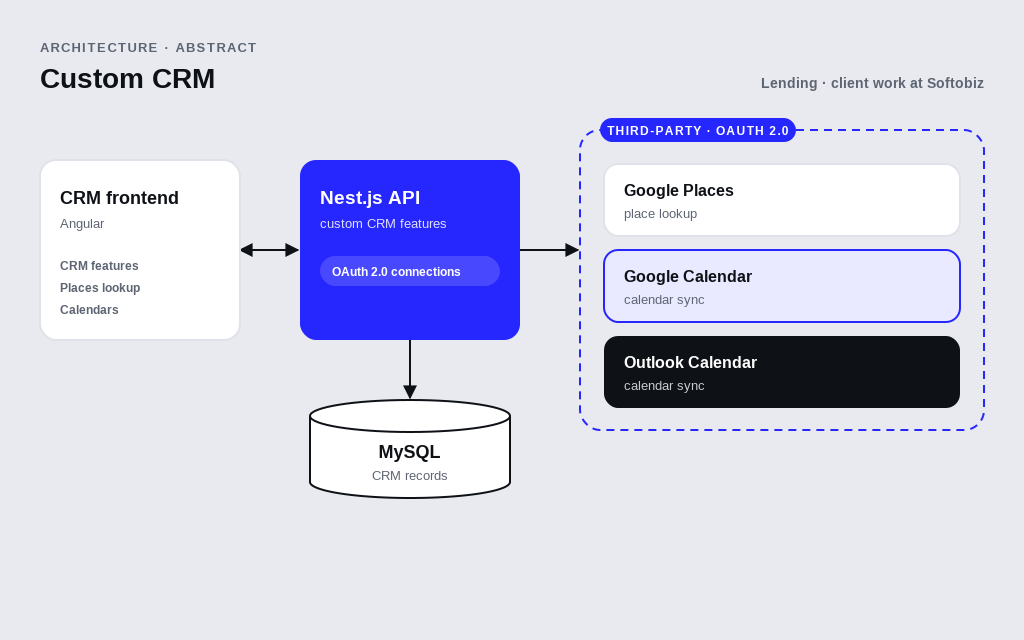
Custom CRM features for American Prime Lending, a lending business, built with the Softobiz team on Angular, Nest.js and MySQL. They include Google Places and Google and Outlook Calendar integrations with OAuth 2.0 sign-in.

Contributed to American Prime Lending's custom customer relationship management (CRM) application while at Softobiz.

Last updated

Client
American Prime Lending
Industry
Lending
Engagement
Custom CRM features, built with the Softobiz team
Stack
  • Angular
  • Nest.js
  • MySQL
  • OAuth 2.0
  • Google Places
  • Google Calendar
  • Outlook Calendar
Abstract architecture of a custom CRM with Google Places and calendar integrations

01 / constraint

What was the problem?

The CRM needed custom features across an Angular, Nest.js and MySQL stack, and had to connect securely to Google Places and to Google and Outlook calendars.

02 / solution path

How was it built?

  1. 01

    Custom CRM features

    Worked with the Angular, Nest.js and MySQL teams to build custom CRM features.

  2. 02

    Places and calendar integrations

    Integrated the Google Places and Google/Outlook Calendar APIs with OAuth 2.0 authentication.

No numeric outcome is attached to this study. The system flow is documented instead of overstated.

Back to index
Privacy choices

Necessary storage keeps this site working. Optional analytics helps us understand visits and stays off until you choose it.